AXI Lens: A Chemical Image Recognition Tool for Frontier AI
August 14, 2026
A specialist recognition pipeline that reads drug structures more accurately, more reliably, and faster than frontier multimodal models.
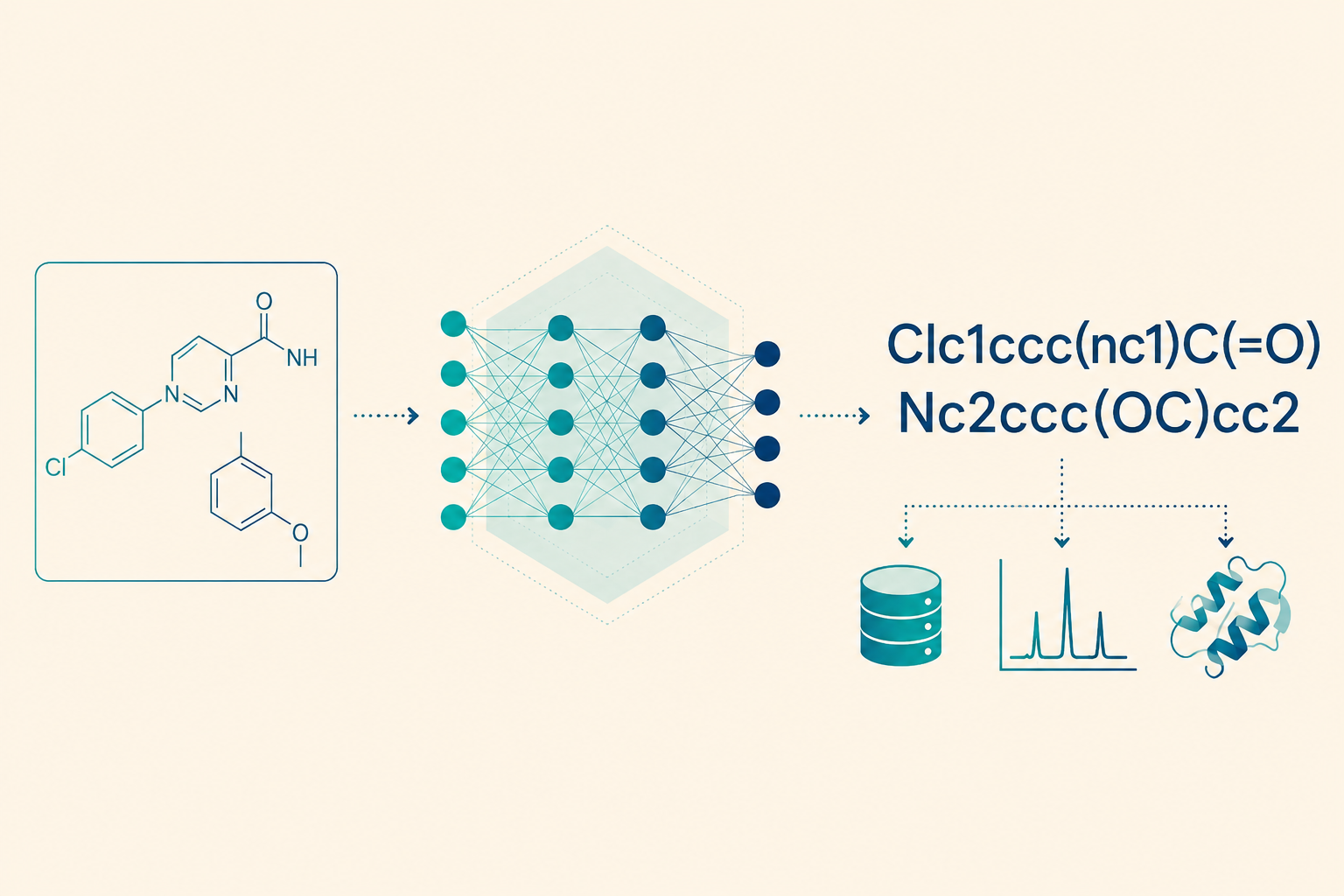
A large share of chemical knowledge is locked inside figures. Structures in papers, patents, and lab records exist as drawings rather than as data, which means machines cannot search, compare, or learn from them directly. AXI Lens closes that gap by focusing on the image to SMILES problem: given a picture of a molecule, return the exact machine readable structure, stereochemistry included. It is a natural question whether today's frontier multimodal models have made such a specialist system unnecessary. We tested exactly that, and the answer is no.
A benchmark built from real drugs: To measure this capability where it matters, we assembled an evaluation set of 100 approved and investigational drugs drawn from the Broad Institute Drug Repurposing Hub, spanning infectious disease and urology. The set covers the full range of conditions a recognition system meets in practice, from clean published diagrams to the degraded scans and photographs where real structures actually live, and every prediction is held to the strictest standard: the exact molecule, stereochemistry included.
AXI Lens against frontier AI: AXI Lens is a specialist system engineered for a single job: converting chemical structure images into exact machine readable structures, with verification built into every prediction. We benchmarked it head to head against today's strongest general multimodal models, Gemini 3.7 Flash, Claude Opus 4.8, and GPT-5.6, each asked to transcribe the same drug images in single queries at its deepest reasoning setting. The metric that matters is the strictest one: the exact structure with stereochemistry included, counting every scheduled query. On standard renderings, AXI Lens delivered 80%. Among the frontier models, GPT-5.6 reached 80%, Claude Opus 4.8 reached 60%, and Gemini 3.7 Flash reached 40%. So the best general model matches AXI Lens on accuracy, and everything else separates them. AXI Lens answered every query, in seconds, running locally at no cost per image. The general models required minutes to hours per batch, metered API calls, and dedicated retry infrastructure, and still left queries unanswered due to timeouts and capacity limits. And where precision matters most, the specialist advantage is sharpest: on stereocenter rich drugs the general models frequently return the correct skeleton but lose the three dimensional assignments, while AXI Lens reads the wedge and hash bonds exactly, and a molecule with the wrong handedness is a different substance.
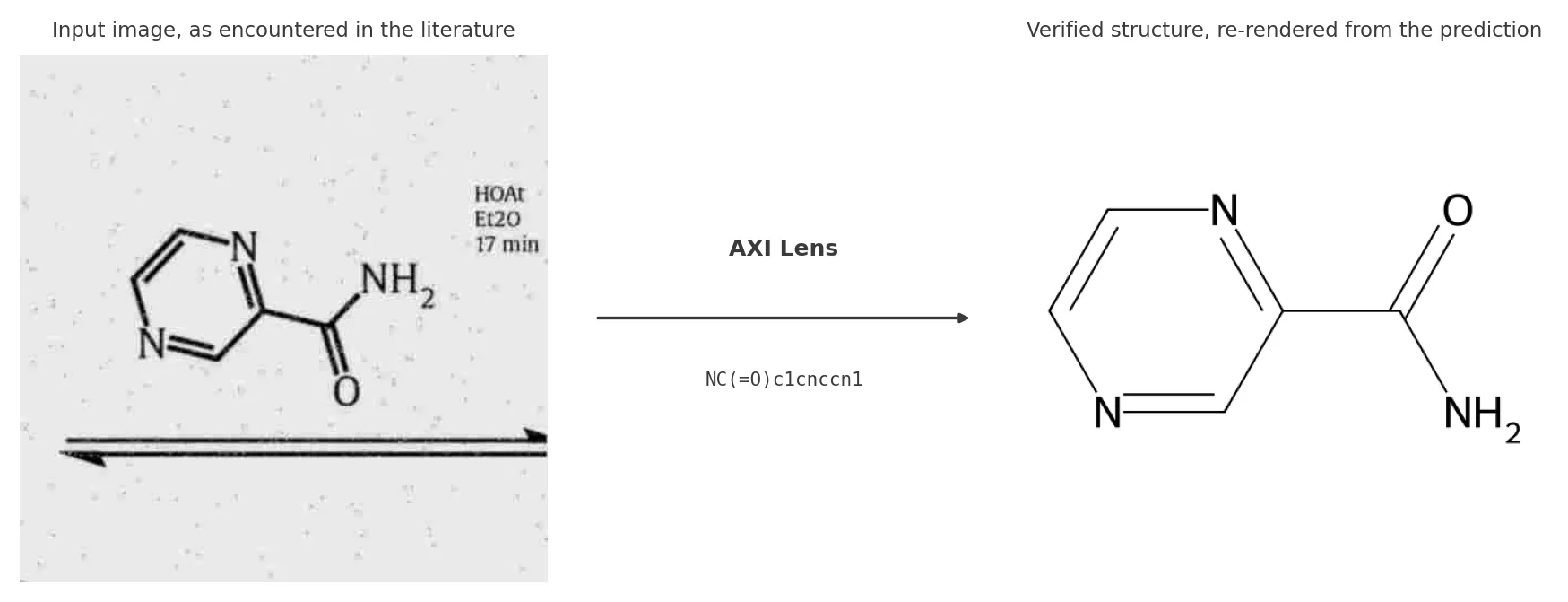
Figure 1. From a degraded literature image to a verified structure. Pyrazinamide, from the benchmark, read through noise, stains, and stray reaction annotations.
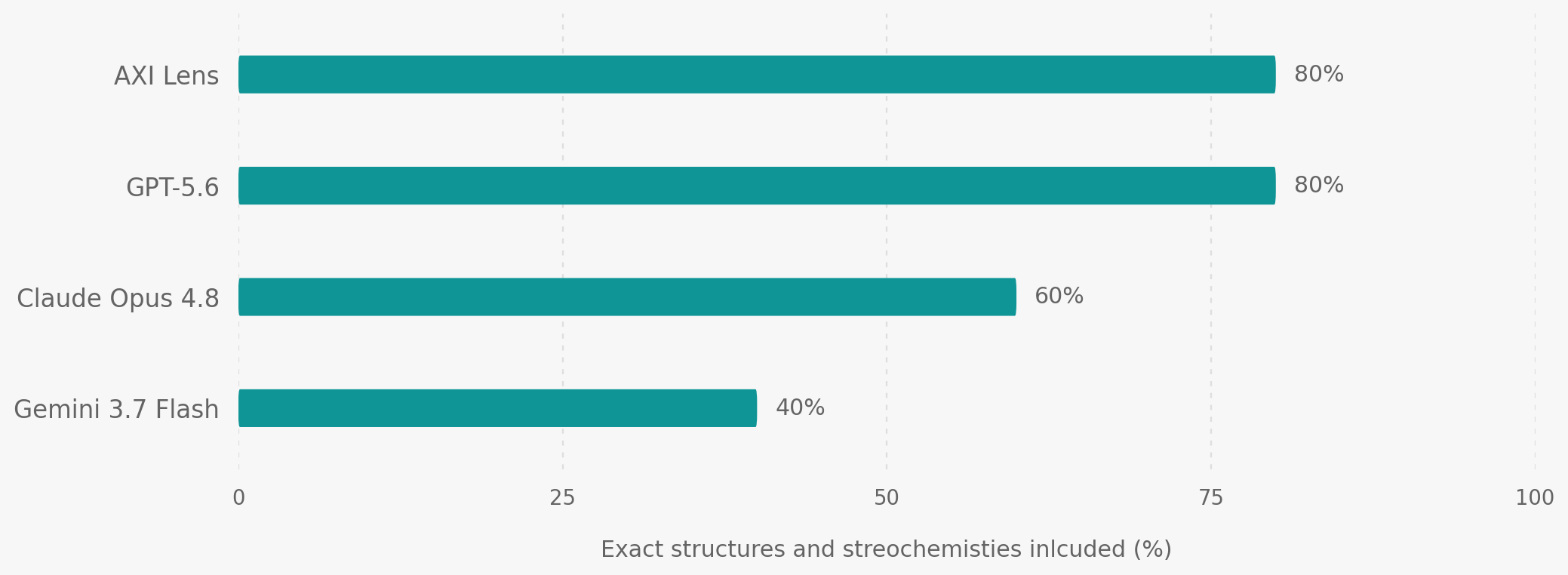
Figure 2. Exact structure recovery on standard renderings from the 100 drug repurposing benchmark, stereochemistry included and every scheduled query counted. NOE Lens against Gemini 3.7 Flash, Claude Opus 4.8, and GPT-5.6.
Three drugs, one head to head: To make this concrete, here are three drugs from the set, with NOE Lens alongside single query answers from Gemini 3.7 Flash, Claude Opus 4.8, and GPT-5.6. On pyrazinamide, a tuberculosis drug, every system agrees. The separation appears exactly where chemistry gets demanding. On amoxicillin, with four stereocenters packed into a fused ring cage, and on tadalafil, with its five ring system, NOE Lens reads the complete structure exactly, while two of the three general models fail. Their answers carry wrong or missing stereochemistry, and under our standard that is simply a failure, no different from misreading an atom: a molecule with different handedness is a different substance, a receptor in the body binds one mirror image and not the other, and reporting the wrong one is reporting the wrong drug.
Verification built into the pipeline: High accuracy alone is insufficient for scientific data; a trustworthy system must also know when to doubt itself. Every AXI Lens prediction therefore passes a battery of automated checks that operate without any reference answer, catching chemically implausible outputs before they enter the record. Stereochemistry receives particular discipline: assignments are reported only when the drawing explicitly supports them, never speculated. The result is predictions that arrive with a measure of confidence attached, which is what allows extracted structures to be used downstream at scale.
What a decoded structure unlocks: The value of this effort compounds downstream. Once an image becomes a verified molecular representation, it connects directly to the computational chemistry toolbox: spectra prediction, co-folding with protein targets, property and ADMET prediction, retrosynthesis planning, database search and deduplication, and training data for chemical AI. Every structure recovered from a figure is one more molecule those methods can reach. The throughline of this effort is reliability. General intelligence is impressive, but chemistry rewards precision, and a system purpose built for structure recognition, verified at every step, currently delivers more of it than the strongest general models, at a fraction of the time and cost. Extending that same dependability to the most heavily degraded scans is where our work goes next. In the meantime, AXI Lens is turning decades of drawn chemistry into a resource that machines, and the scientists working with them, can build on.